

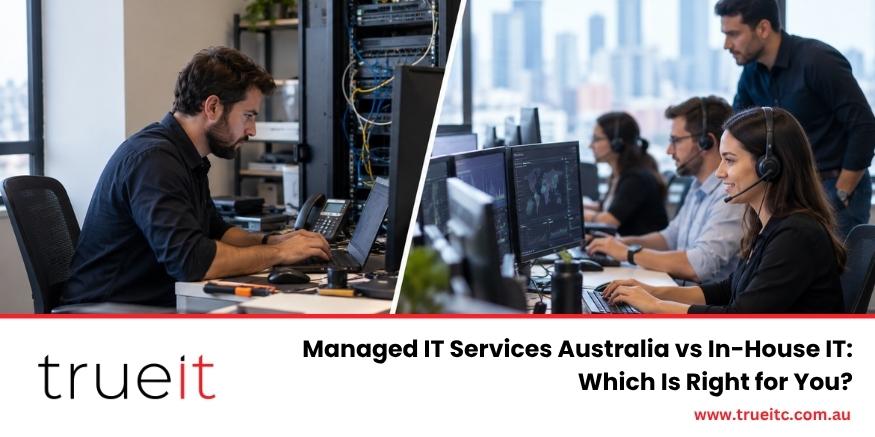
Every business owner across the country eventually hits the same crossroads: do you build an in-house IT team, or do you bring in a specialist partner to look after your technology? It’s a decision that shapes not just your budget, but your resilience, your growth trajectory, and how smoothly your day-to-day operations run.
With cyber threats on the rise and technology becoming more intricate by the year, getting this call right matters more than ever.
For many Aussie businesses, the choice between managed IT services in Australia and a traditional in-house setup isn’t as straightforward as it once was.
Gone are the days when hiring a single IT bloke to handle the printer and the odd software glitch was enough.
Modern businesses need round-the-clock monitoring, robust cyber security, cloud management, and strategic technology planning, all while keeping costs sensible. This blog unpacks both approaches so you can weigh up what genuinely suits your organisation.
Understanding the Two Models
Before diving into comparisons, it helps to understand what each model actually involves.
In-house IT means employing your own technology staff who work exclusively for your business. Key traits include:
- Staff who sit within your office (or remotely, in some cases) and understand your systems intimately
- Direct control over hiring, training, and day-to-day priorities
- Availability that depends entirely on rostering; if your technician is on leave, cover can be thin
- A smaller pool of knowledge concentrated in one or two people
Managed IT services, on the other hand, involve outsourcing your technology needs to an external provider who takes responsibility for monitoring, maintaining, securing, and often strategically guiding your IT environment. Providers offering IT support services Australia-wide typically bring:
- A full bench of specialists, including network engineers, cyber security consultants, cloud architects, and help desk technicians
- Established processes and tools rather than ad-hoc fixes
- Coverage that isn’t dependent on a single staff member’s availability
- Broader exposure to different industries, systems, and threat patterns
Both models have their place, and the right fit often depends on your business size, budget, growth ambitions, and how critical technology is to your operations.
The Cost Conversation
Cost is usually the first thing that gets business owners thinking seriously about this decision.
Building an in-house team means factoring in:
- Salaries and superannuation for each staff member
- Recruitment and onboarding costs
- Ongoing training to keep skills current
- Leave entitlements and cover for absences
- Tools, licences, and equipment your staff need to do their jobs properly
For a small to mid-sized business, hiring even a modest internal team, say, two or three technicians, can quickly become a significant line item, particularly when looking at IT support Sydney businesses rely on or when considering the going rate for skilled IT professionals in a competitive market like Sydney or Melbourne.
Managed IT solutions in Australia typically operate on a predictable, subscription-style pricing structure instead. Benefits of this model include:
- A set monthly fee based on your needs, rather than variable staffing costs
- Access to an entire team of specialists without carrying full-time salary overhead
- No paying for downtime: when in-house staff is on leave or off sick, systems can be left exposed, whereas a managed provider builds in redundancy.
- Fewer surprise expenses when equipment fails or a security incident occurs.
That said, larger enterprises with complex, highly specific technology environments might find that an in-house team, once established, becomes more cost-effective at scale. It really comes down to the size and complexity of your operations.
Expertise and Skill Coverage
One of the trickiest parts of running an in-house IT department is skill coverage. Technology moves fast, and no single technician, however talented, can be an expert in every discipline at once. Areas commonly stretched thin in small internal teams include:
- Networking and infrastructure
- Cyber security and threat monitoring
- Cloud platforms and migrations
- Data backup and compliance
- End-user support across multiple systems
Outsourced IT services in Australia solve this problem by giving you access to a diverse team with specialised skills. A reputable provider typically offers:
- Dedicated cyber security consultants rather than a generalist covering everything
- Cloud specialists focused solely on platform management and cloud migration Sydney businesses require for smooth transitions
- Infrastructure engineers who handle networking and hardware separately from support tickets
- Expert-level coverage across every facet of your technology stack, rather than a jack-of-all-trades approach
This is particularly valuable for businesses dealing with sensitive data, regulatory obligations, or complex multi-site operations where specialised expertise is essential.
Outsourced IT services in Australia provide access to experienced professionals who stay current with emerging technologies, industry certifications, and best practices, helping businesses remain secure, compliant, and prepared for future challenges.
Availability and Response Times
Technology issues can occur at any time, and delays in resolving them can disrupt operations, reduce productivity, and impact customer experience. Whether it’s a server failure in the middle of the night, a phishing attack during a public holiday, or a critical system outage outside business hours, relying solely on standard office-hour support can leave businesses vulnerable.
Providers of managed IT services in Australia offer continuous monitoring and expert support, helping organisations detect and resolve issues before they become major disruptions.
Key benefits include:
- 24/7 system monitoring and rapid incident response
- Early detection of performance issues and security threats
- Reduced downtime through proactive maintenance
- Reliable support across multiple locations and time zones
- Consistent coverage during staff leave or after business hours
With dependable IT support services Australia, businesses gain around-the-clock technical assistance, ensuring systems remain secure, operational, and ready to support day-to-day business activities without unnecessary interruptions.
Scalability and Flexibility
Growth is exciting, but it also brings technology headaches. Adding new staff, opening new locations, or expanding your service offerings all place additional demands on your IT infrastructure.
With an in-house team, scaling up typically involves:
- A lengthy recruitment process to find the right candidates
- Onboarding time before new hires are fully productive
- Uncertainty around whether you’ve hired the correct skill set for what’s coming next
- Difficulty scaling down if business needs change, given employment obligations
Managed IT solutions in Australia offer far more flexibility here, including:
- The ability to ramp support up or down based on current needs
- No administrative burden of hiring or letting staff go
- Service delivery that adjusts to match your pace of growth, whether onboarding new employees, migrating to a new cloud platform, or opening a second office
- Agility that suits fast-moving industries where technology needs shift quarter to quarter
By choosing managed IT solutions, businesses can scale technology resources quickly without the delays and costs associated with recruiting, onboarding, and training additional in-house staff.
Cyber Security Considerations
The Importance of Proactive Cyber Security
Cyber threats continue to evolve, making proactive security essential for businesses of every size. Protecting against ransomware, phishing, data breaches, and other emerging threats requires specialised expertise, advanced security tools, continuous monitoring, and regular staff awareness training.
For many organisations, maintaining this level of protection in-house can be both costly and resource-intensive.
Why Managed Support Makes a Difference
Partnering with a managed IT provider helps businesses strengthen their security posture through ongoing protection and expert support.
Key advantages include:
- 24/7 threat monitoring and incident response
- Firewall and endpoint security management
- Email protection and phishing prevention
- Vulnerability assessments and security testing
- Disaster recovery and compliance support
Strategic Planning and Business Alignment
Technology should never exist in isolation from your broader business goals. Ideally, your IT strategy supports where the business is heading, whether that’s expanding into new markets, improving customer experience, or streamlining internal processes.
In-house teams, while close to day-to-day operations, often face limitations such as:
- Limited bandwidth for stepping back to plan technology roadmaps
- Being too busy firefighting daily tickets to focus on the bigger picture
- A lack of strategic training beyond technical troubleshooting
Many managed providers include strategic consulting as part of their service, offering:
- Guidance on technology investments aligned with business goals
- Support for digital transformation initiatives
- Long-term planning rather than reactive decision-making
- Regular reviews of your technology environment, with recommendations for improvement and future budgeting
Partnering with providers that offer IT support services in Australia enables organisations to align technology investments with business objectives while ensuring their IT environment remains secure, efficient, and ready for future growth.
Data Backup, Compliance, and Disaster Recovery
Data loss can be catastrophic for any business, whether it stems from hardware failure, human error, or a malicious attack. Having a solid backup and disaster recovery plan isn’t optional anymore; it’s a fundamental part of running a responsible operation.
In-house teams can certainly implement backup solutions, but common challenges include:
- Maintaining and regularly testing systems, which requires discipline
- Resources often deprioritised when day-to-day fires need putting out
- Inconsistent documentation of recovery procedures
Managed providers typically build the following into their standard offering:
- Automated, regularly monitored backups
- Compliance support aligned with regulatory requirements
- Disaster recovery planning with defined recovery timeframes
- Regular testing of recovery procedures, something frequently overlooked by stretched internal teams but absolutely critical when disaster actually strikes.
Making the Right Choice for Your Business
There’s no single IT model that suits every organisation. The best approach depends on your business size, operational complexity, budget, and long-term technology goals.
Choose managed IT services if:
Your business wants predictable costs, access to specialist expertise, proactive support, and scalable technology solutions without the expense of maintaining a full in-house IT team.
Choose in-house IT if:
Your organisation relies on highly specialised systems that require dedicated, on-site expertise and continuous operational knowledge.
Consider a hybrid approach if:
You want internal IT resources for daily operations while leveraging external specialists for cyber security, cloud management, strategic projects, and after-hours support.
Partner with TrueIT for Reliable IT Support
Whether you require fully managed IT services or specialised cyber security expertise, having the right technology partner helps improve efficiency, strengthen security, and minimise downtime.
At TrueIT, we deliver tailored IT solutions designed to keep your systems secure, scalable, and performing at their best.
With comprehensive outsourced IT services in Australia and tailored managed IT solutions in Australia, TrueIT helps businesses simplify IT management, strengthen cyber security, and build scalable technology environments that support long-term success.
Contact TrueIT today to discover how our managed IT services can support your long-term growth and digital transformation.
FAQs About Managed IT Services vs In-House IT
- How do I decide between managed IT support and an in-house IT team?
The right choice depends on your business size, budget, technology requirements, growth plans, and the level of expertise your organisation needs.
- Is managed IT support suitable for small and medium-sized businesses?
Yes. It provides access to specialist expertise, proactive monitoring, stronger security, and predictable costs without the expense of maintaining a full internal team.
- What are the biggest advantages of outsourcing IT management?
Outsourcing offers 24/7 support, improved cybersecurity, scalable services, access to experienced professionals, and reduced operational overheads.
- Can businesses combine internal IT staff with external IT support?
Yes. A hybrid approach allows businesses to manage daily operations internally while using external specialists for security, cloud management, and strategic technology projects.
